Vaillant data plate: where the serial number and GC number are
By Jordan Valentine-Dunn, Gas Safe registered engineer · 21 July 2026 · Updated 6 September 2026
On a Vaillant boiler the serial number is on a plastic plate at the front of the appliance, and the GC number is on the data plate, which Vaillant fits to the underside at the factory. The current ecoTEC plus is the exception: its serial sits under the front panel and its main data plate behind the electronics box.
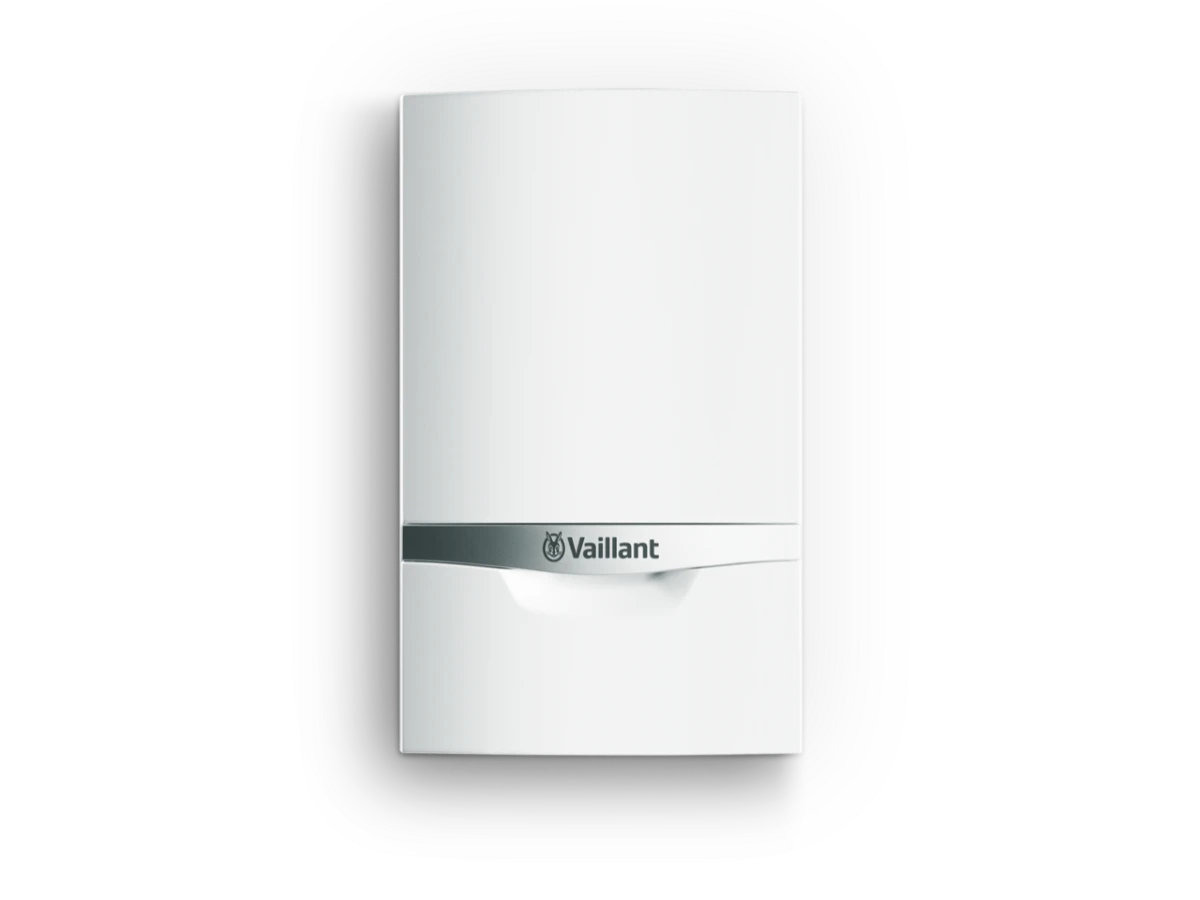
Where are the serial number and data plate on a Vaillant boiler?
That depends on the range, so here is each one as Vaillant's own manuals put it. The serial plate is the small plastic label you can read without tools. The data plate is the larger one carrying the product designation, gas category and connection pressure, outputs, maximum water pressures, electrical rating, NOx class and DSN code. Older Vaillant documents call it the identification plate, which is the same label under a different name.
| Range | Serial number plate | Data plate |
|---|---|---|
| ecoTEC plus, current range (VU and VUW ..CS/1-5) | On the underside of the front panel, and repeated on the data plate | Two plates. The main one is on the rear of the electronics box, the second on the top of the boiler |
| ecoTEC plus, earlier range (VU and VUW ..6/5-5) | Plastic label behind the front flap, and on the data plate | Underside of the boiler |
| ecoTEC plus open vent (VU ..6/6-5 OVZ) | Plate behind the front flap, held in a plastic strap. Can also be shown on the display | Underside of the boiler |
| ecoTEC exclusive (VU 256/5-7, VUW 356/5-7 and 436/5-7) | Plastic label behind the front flap, and on the data plate | Underside of the boiler |
| ecoFit pure (VU and VUW ..6/6-3) | Plastic plate at the bottom of the front casing | Underside of the boiler |
| ecoTEC pro (VUW ..6/5-3) | Plastic label at the bottom of the front casing, and on the data plate | Underside of the boiler |
Vaillant's homeowner guidance puts it more loosely, saying the serial number will usually be underneath the boiler or on the control panel. Both are true, because on most ranges the number is printed twice. If you are on your knees with a torch under an ecoTEC and finding nothing, check the front of the appliance before you assume the plate has been taken off.
What is a GC number?
A GC number is the Gas Council number, a seven digit appliance reference written as 00-000-00 that identifies one exact appliance variant. Gas appliances sold in the UK are registered with one, and it is the number a merchant or a parts catalogue will ask you for. Two boilers can wear the same range badge and still take different parts, and the GC number is what settles which is on the wall. It is also the safest identifier to write on a gas safety record, because it does not depend on how the customer describes their boiler.
How old is my Vaillant boiler?
Read characters three to six of the serial number: two for the year, then two for the week. Vaillant sets this out in the installation and maintenance instructions for the ecoTEC and ecoFit ranges, and Vaillant UK's homeowner guidance adds that a serial number consists of 28 characters, starts with 21 and ends with the letter N followed by one more digit. Only the first sixteen characters are needed to date and identify the appliance.
| Characters | What Vaillant says it means | Worked example: 2118070010021824 |
|---|---|---|
| 1 to 2 | Fixed opener on a current Vaillant serial number | 21 |
| 3 to 4 | Year of production | 18, so 2018 |
| 5 to 6 | Week of production | 07, so mid-February |
| 7 to 16 | Product article number | 0010021824, the article number for an ecoTEC plus 832 combi |
| 17 to 20 | Place of manufacture | A Vaillant internal code, not published in the manuals |
| 21 to 28 | Not set out in the manuals. Vaillant says the number ends with N and one more digit | Not needed to date the boiler |
Second worked example: a serial beginning 2121340010020390. The 21 is the fixed opener, 21 gives 2021, 34 gives week 34, so late August 2021, and 0010020390 is the article number for an ecoFit pure 830 combi. Watch the gap between build and installation. A boiler can sit in a merchant's warehouse for months, so treat the decoded date as the earliest the appliance can be, then check the Benchmark logbook or the Gas Safe notification for when it actually went on the wall.
What is the GC number for my Vaillant boiler?
Look it up by the type designation, the VU or VUW code, rather than by the marketing name. Vaillant prints the Gas Council Number for every model near the front of that model's installation and maintenance instructions, and the numbers below are read straight from the current manuals. VU is a system or open vent boiler, VUW is a combi.
| Model | Type designation | GC number |
|---|---|---|
| ecoTEC plus 610 | VU 10CS/1-5 (N-GB) | 41-694-45 |
| ecoTEC plus 615 | VU 15CS/1-5 (N-GB) | 41-694-46 |
| ecoTEC plus 620 | VU 20CS/1-5 (N-GB) | 41-694-47 |
| ecoTEC plus 625 | VU 25CS/1-5 (N-GB) | 41-694-48 |
| ecoTEC plus 630 | VU 30CS/1-5 (N-GB) | 41-694-49 |
| ecoTEC plus 635 | VU 35CS/1-5 (N-GB) | 41-694-50 |
| ecoTEC plus 826 | VUW 20/26CS/1-5 (N-GB) | 47-044-92 |
| ecoTEC plus 832 | VUW 25/32CS/1-5 (N-GB) | 47-044-93 |
| ecoTEC plus 836 | VUW 30/36CS/1-5 (N-GB) | 47-044-94 |
| ecoTEC plus 840 | VUW 30/40CS/1-5 (N-GB) | 47-044-95 |
| ecoTEC exclusive 627 | VU 256/5-7 (H-GB) | 41-694-02 |
| ecoTEC exclusive 835 | VUW 356/5-7 (H-GB) | 47-044-66 |
| ecoTEC exclusive 843 | VUW 436/5-7 (H-GB) | 47-044-67 |
| ecoFit pure 612 | VU 126/6-3 (H-GB) | 41-694-03 |
| ecoFit pure 615 | VU 156/6-3 (H-GB) | 41-694-04 |
| ecoFit pure 618 | VU 186/6-3 (H-GB) | 41-694-05 |
| ecoFit pure 625 | VU 256/6-3 (H-GB) | 41-694-06 |
| ecoFit pure 630 | VU 306/6-3 (H-GB) | 41-694-07 |
| ecoFit pure 825 | VUW 256/6-3 (H-GB) | 47-044-68 |
| ecoFit pure 830 | VUW 306/6-3 (H-GB) | 47-044-74 |
| ecoFit pure 835 | VUW 356/6-3 (H-GB) | 47-044-70 |
For any model not listed, including the earlier ecoTEC plus ..6/5-5 generation and the ecoTEC pro, open the Literature and manuals finder on Vaillant's professional site, download the installation and maintenance instructions for that boiler and read the Gas Council Number table in the notes on the documentation, near the front. Vaillant lists GC no. as a data plate field in the ecoFit pure and ecoTEC plus open vent manuals, so on those ranges the plate under the boiler gives it to you directly. The ecoTEC plus combi and system, exclusive and pro manuals do not show a GC field in their plate keys, which is why the manual is the dependable route when a plate is scorched, painted or unreachable.
How do I bring the serial number up on the display?
On the ecoTEC plus and ecoTEC exclusive generations with the small mono display and two selection buttons, the serial number sits in the end user menu under Information.
Start from the basic display
Leave the boiler on its normal screen. If a fault is active the display switches to the error message instead, so note or clear that first.
Press the two selection buttons together
Vaillant's operating instructions list the left and right selection buttons, pressed at the same time, as the way to call up the menu.
Scroll to Information
Use the minus or plus button to move through the menu entries.
Open Information and read Serial number
The operator level lists Contact details and Serial number under Information. It shows as a permanent value, so there is nothing you can change by accident.
On the current ecoTEC plus, read the panel instead
The current VU and VUW CS/1-5 range has no serial number entry in its end user menu. Vaillant's display route there is MENU, SETTINGS, Installer level, QR service code, which you scan with the myVAILLANT pro app. The serial itself is printed on the underside of the front panel and on the data plate.
What should you copy onto the record?
- Make and model exactly as the data plate writes it, not as the customer describes it.
- GC number in full, including the dashes, so the appliance variant is unambiguous.
- Serial number from the front plate or the display, which also gives you the build year and week.
- Gas category and connection pressure, so the appliance can be checked against the supply on site.
- Anything that does not match the Benchmark logbook or the previous record, noted as found.
Only a Gas Safe registered engineer can service, size, install or certify a boiler. This is general guidance on where the identification data sits. Always work to the manufacturer's current instructions for the specific model in front of you.
Boiler reference
Other makes
Reading the plate is the easy part. Typing it twice, once on the pad and again in the office, is where the mistakes creep in. Manifold's PlateScan reads the make, model and GC number straight off the data plate photo, drops them into the CP12 or service record, and keeps the appliance history against the property so the next visit starts with the numbers already filled in.
See how Manifold helps
Frequently asked
Sources
- Vaillant, ecoTEC plus VU/VUW installation and maintenance instructions (0020308118_06)
- Vaillant, ecoTEC plus VU, VUW ..6/5-5 installation and maintenance instructions (0020244997_07)
- Vaillant, ecoTEC plus VU ..6/6-5 OVZ open vent installation and maintenance instructions (0020238195_08)
- Vaillant, ecoTEC plus operating instructions (0020245033_02)
- Vaillant, ecoTEC plus operating instructions (0020308119_05)
- Vaillant, ecoTEC exclusive VU 256/5-7 installation and maintenance instructions (0020193966_04)
- Vaillant, ecoTEC exclusive combi installation and maintenance instructions (0020193968_05)
- Vaillant, ecoFit pure 825 to 835 installation and maintenance instructions (0020230531_07)
- Vaillant, ecoFit pure 612 to 630 installation and maintenance instructions (0020230533_07)
- Vaillant, ecoFit pure combi operating instructions (0020230532_03)
- Vaillant, ecoTEC pro VUW ..6/5-3 installation and maintenance instructions (0020244995_05)
- Vaillant UK, myVaillant Web (serial number guidance)
- Vaillant UK, guarantee registration (28 digit serial number)
- Vaillant, Literature and manuals finder